
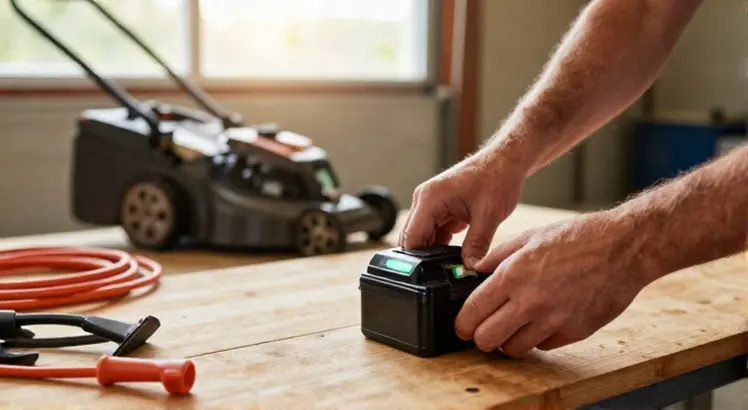
Picture this. You are ready for the first mow of spring. You turn the key on your riding mower, but all you hear is a click. A dead mower battery is a common frustration, but it is almost always a simple fix if you know the right way to recharge it.
Learning how to charge a mower battery safely will save you money on replacements and get you back to cutting grass quickly. It does not matter if you own a massive zero-turn or a compact walk-behind with an electric start. This guide will walk you through every step, battery type, and safety rule.

WORX Nitro Cordless Lawn Mower, 21″ Electric Mower, 2 × 5.0 Ah Batteries & Charger Included, WG752
Check PriceUnderstanding Your Mower Battery Type
Before you connect a single clamp, you have to identify what kind of battery powers your machine. Mowers generally use two distinct categories. Those are standard 12-volt starting batteries and the dedicated battery packs found on cordless electric models. Treating them the same way can cause permanent damage.
Lead-Acid and AGM Batteries
The vast majority of gas-powered riding mowers and lawn tractors use a 12-volt lead-acid battery. These are similar to car batteries but smaller in scale. You will also find Absorbent Glass Mat, or AGM, batteries that are sealed and maintenance-free. Both types require a charger that delivers a low, controlled amp rate.
If you are unsure which specific replacement you might need in the future, reviewing a comprehensive lawn mower battery guide can clarify cold cranking amps and terminal types. A standard flooded battery has removable caps on top so you can check the fluid level. An AGM battery is sealed, so you never add water.
Lithium-Ion Lawn Tractor Batteries
Modern riders are gradually adopting lightweight lithium-ion phosphate (LiFePO4) batteries. These are not the same as the power tool batteries on handheld devices. They require a specialized charger with a lithium charging profile. Using an old lead-acid charger on a lithium battery will trigger its protection circuit and fail to charge.
Before You Start: Safety and Preparation

EGO POWER+ 21″ Cordless Electric Lawn Mower Kit, Self-Propelled – LM2135SP
Check PriceCharging a battery involves hydrogen gas and electrical current, so safety comes first. Always work in a well-ventilated area, preferably outdoors or in a garage with the door wide open. Never charge a battery near an open flame, a pilot light, or while smoking.
- Put on safety glasses and acid-resistant gloves.
- Remove any metal jewelry like rings or watches.
- Inspect the battery case for cracks or leaks. If the case is bulging, do not charge it.
- Clean the terminals with a wire brush and a mixture of baking soda and water if you see corrosion.
Gather your tools. You will need a compatible battery charger or maintainer, a clean rag, and a set of wrenches to disconnect the terminals if you remove the battery from the machine. Distilled water is necessary only if you have a flooded lead-acid battery with low electrolyte levels.
Step-by-Step: How to Charge a Mower Battery

Greenworks 80V 21″ Brushless Cordless (Push) Lawn Mower, (2) 2.0Ah Batteries and 30 Minute Rapid Charger Included
Check PriceYou can charge the battery while it is still mounted in the mower, or you can remove it. Removing the battery is safer for long, overnight charges because it isolates the electrical system. Regardless of your choice, the sequence of connecting the charger is critical.
Charging with a Standard Battery Charger
Start by making sure the charger is unplugged from the wall outlet. Identify the positive terminal, which is marked with a plus sign and usually has a red cable. The negative terminal has a minus sign and a black cable.
Attach the red charger clamp to the positive battery post first. Then attach the black clamp to a clean, unpainted metal surface on the engine block or mower frame, away from the battery. This grounding step prevents sparks near the battery, where hydrogen gas may linger.
If the battery is out of the mower, connect the black clamp directly to the negative terminal. Set the charger to a low amperage. A rate of 2 to 6 amps is ideal for mower batteries. Fast charging at 10 amps or higher generates excessive heat and shortens battery life significantly.
Plug the charger into the wall. Monitor the amp meter. As the battery charges, the needle will drop toward zero. A fully charged 12-volt battery should read around 12.6 to 12.8 volts on a multimeter after resting. Refer to expert lead-acid charging guidelines for exact voltage stages and temperature adjustments.
Using a Trickle Charger or Maintainer
A trickle charger replenishes energy very slowly, while a smart maintainer monitors the voltage and switches to a float mode. Maintainers are ideal for winter storage. Hook them up exactly like a standard charger, but you can leave them connected for months without overcharging.
I recommend a smart automatic float charger for any mower that sits idle for more than two weeks. It prevents sulfation, which is the number one killer of lead-acid batteries. The process is completely hands-off once you connect the ring terminal harness to the battery posts permanently.
Can You Jump Start a Mower Battery?

EGO 21″ Self Propelled Mower With Dual Toggle Kit (6.0Ah, 320W Charger)
Check PriceYes, but you must be careful. You can jump start a 12-volt riding mower battery from a car or a portable jump pack. However, never start the car’s engine while the cables are connected. A car alternator pushes high amps that can destroy the mower’s voltage regulator or fry the battery instantly.
Connect the positive cable to the dead positive terminal, then to the donor positive. Connect the negative cable to the donor negative, and the final negative clamp to a bare metal ground on the dead mower. Crank the mower immediately. Once it starts, disconnect the jumper cables in reverse order as soon as possible.
How to Charge a Cordless Electric Mower Battery Pack
The keyword mower battery also applies to the lithium-ion packs on battery-powered walk-behind mowers. These packs are entirely different from lead-acid starters. Always use the factory charger supplied by the manufacturer, such as the charger that came with your Greenworks, EGO, or Ryobi tool.
Remove the battery pack from the mower. Let it cool down for at least 30 minutes if you just finished mowing. Hot batteries will refuse to charge or damage the internal cells. Slide the pack onto the charger and wait until the indicator light shows solid green. Do not leave lithium-ion packs on the charger indefinitely unless the manufacturer states it has a maintenance mode.
Troubleshooting Common Charging Problems
Sometimes you follow every step and the battery still refuses to wake up. A few diagnostic checks can pinpoint the issue before you spend money on a new unit. First, measure the voltage with a digital multimeter. A fully dead 12-volt reading under 10.5 volts indicates a shorted cell.
- The charger shows no amp draw: Check the internal fuse in the charger or the AC outlet with a lamp. A fully sulfated battery will act like an open circuit.
- The battery charges but drains overnight: There is a parasitic drain in the mower’s wiring harness. Disconnect one battery cable and test for sparking.
- The battery gets extremely hot during charging: This signals internal resistance and imminent failure. Stop charging immediately and replace it.
For riders that sit through a harsh winter, the battery often freezes when left in a discharged state. A frozen battery should thaw completely in a warm room before you attempt to charge it. Look for a bulging case, which means the battery is scrap metal at that point.
Extending Battery Life Through Proper Charging
Charging correctly is the most important habit, but maintenance seals the deal. For flooded lead-acid batteries, check the water level every month during mowing season. Add only distilled water to cover the lead plates, and never add acid. AGM and lithium batteries do not need water, but they benefit from clean terminal connections.
If your battery is already struggling and you need a new one for a high-horsepower tractor, picking a reliable unit matters. Reviewing profiles on high-quality riding mower batteries can help you match the right cranking amps to your engine size. A slightly larger amp-hour rating is fine, but the battery must fit securely in the compartment.
Also, consider your storage conditions. Heat accelerates corrosion. Cold drains capacity. Disconnect the negative cable if you store the mower for a month or more, or keep a smart maintainer plugged in. These small actions prevent the sulfation that wears out terminals and plates before their time.
Frequently Asked Questions
How long does it take to charge a dead mower battery?
With a 2-amp charger, a typical 18Ah battery can take 8 to 10 hours to reach full capacity from completely dead. A 6-amp charger will do it in about 3 to 4 hours. Slow charging is always better for battery health than rushing with high amperage.
Can I charge a mower battery with a car charger?
You can, but only if the car charger has a low maintenance mode of 2 to 6 amps. Many large automotive wheeled chargers push 40 amps or more, which will warp the plates inside a small mower battery. Check the charger settings carefully before connecting.
Is it safe to leave a battery charger on overnight?
It is safe only if you are using an automatic smart charger or maintainer that turns off when the battery reaches full voltage. A manual charger left unattended can overcharge the battery, boil the electrolyte, and create a fire hazard. Always read your charger’s manual first.
Why does my mower battery keep dying?
Frequent dying points to a charging system problem on the mower itself, such as a faulty stator or voltage regulator, or a constant electrical draw. A battery that simply cannot hold a charge anymore has reached the end of its cycle life and needs replacement.
Conclusion
Knowing how to charge a mower battery properly is the difference between a reliable start every time and endless frustration in the garage. The process centers on low, slow charging, strict attention to terminal polarity, and the right equipment for your battery chemistry. Match the charger to the battery, whether it is flooded lead-acid, AGM, or lithium.
Start your routine today. Clean the terminals, test the voltage, and hook up a smart maintainer if you are not mowing weekly. With these steps, you will extend the life of your battery dramatically and ensure your mower fires up the moment you need it. A little electrical respect goes a long way in the yard.
