
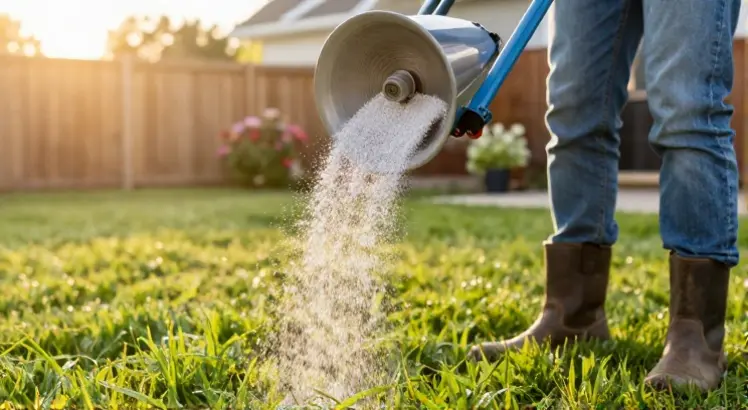
Getting a deep, emerald-green lawn is not just about buying the most expensive bag of fertilizer. The real magic lies in how you apply it. If you are looking for the best method for how to spread fertilizer on lawn, you have come to the right place. Many homeowners accidentally damage their grass simply because they rush the application process.
Uneven distribution can lead to zebra striping, where dark green stripes alternate with pale yellow ones. Even worse, over-application causes chemical burns that turn your grass brown. This guide cuts through the confusion and gives you professional techniques to feed your lawn safely.
Preparing to Fertilize Your Lawn

Before you touch a single granule of fertilizer, you must prepare the turf. Putting food on a lawn that isn’t ready is a waste of money. The grass needs to be in a state where it can actually absorb the nutrients you are delivering.
Reading the Weather and Soil Moisture
Timing is everything in lawn care. The ideal time to spread granular fertilizer is when the grass is dry but rain is expected within 24 to 48 hours. If rain isn’t in the forecast, you must water the lawn yourself. Dry granules sitting on leaf blades without water can sit for days and fail to activate, and walking on the lawn during this time will knock the product off the surface.
You should also avoid applying fertilizer during a drought or heatwave. When the lawn is dormant and brown from heat stress, forcing it to grow through fertilization can kill it. Similarly, avoid fertilizing right before a torrential downpour, as heavy rain will wash your expensive nutrients into the storm drains rather than into the soil.
Choosing the Right Spreader

Amazon Basics Fertilizer Spreader
Check PriceYou generally have two choices: a broadcast spreader or a drop spreader. Understanding the difference is critical for achieving full coverage. The type you choose changes how you walk and how you calculate your overlap.
- Broadcast (Rotary) Spreader: Fling granules out in a wide 6 to 10-foot swath. This is the fastest tool for large yards. It takes less time but requires strict discipline with overlap patterns because the edges of the spread pattern are feathered and less dense.
- Drop Spreader: Lays fertilizer straight down between the wheels. It is incredibly precise and perfect for avoiding sidewalks and flower beds. However, it takes longer, and you must wheel-track carefully to avoid visible missed stripes.
If you are new to lawn care, you might find a high-quality tool simplifies the process significantly. Before you begin, you should inspect your equipment to ensure it operates freely. A rusty hopper or clogged wheels can ruin your rate calibration.
For a deep dive into selecting the best model for your yard size, read our guide on the best fertilizer spreader for lawn to find one that fits your budget and property size.
Step-by-Step Guide on How to Spread Fertilizer on Lawn

VEVOR Broadcast Spreader 50LBS
Check PriceNow we get into the actual application mechanics. This process relies on a technique called half-rate double-pass. This method guarantees that no part of your lawn gets a double dose of heavy nitrogen. It is the single best way to eliminate the risk of streaks.
Calibrating the Spreader Settings
Never trust the dial on the spreader blindly. The 5 on a Scotts spreader does not equal the 5 on an Earthway spreader. Always look at the back of your fertilizer bag. The manufacturer often prints specific settings for popular spreader models.
If the bag lacks settings for your brand, use the trial method. Pour a known weight of fertilizer, like 5 pounds, into the hopper. Set the dial to a very low opening. Push the spreader across a known small space, such as 200 square feet, and see how much you used. Adjust the dial up or down until you are applying the correct rate per 1,000 square feet.
The Headland Strip Technique
Always start by creating a firm headland or border strip around the entire perimeter of your lawn. Walk a single pass around the edges. This creates a turning zone, allowing you to open the spreader after the turn, not during it. Spreading while turning sharply dumps excess fertilizer, creating a dark green halo around your yard that looks unnatural.
Mastering the Half-Rate Double-Pass
Set your spreader dial to deliver exactly half of the recommended application rate. You are going to cover the entire lawn twice. For the first pass, walk back and forth in one direction, say north to south. Once finished, make the second pass perpendicular to the first, walking east to west.
This cross-hatch pattern mathematically eliminates the chances of a miss. When you shut the spreader off to turn, walk a few steps into the fresh strip before opening the hopper again. This engages the impeller gradually and prevents a pileup of granules at the turn point.
Running the Spreader with Precision
Your walking style directly affects the outcome. Broadcast spreaders are calibrated for a specific walking speed, usually 3 mph, which is a brisk walking pace. A drop spreader requires you to look backward at the wheel marks every few seconds to ensure you aren’t leaving a ridiculously thin gap between passes.
Always walk the spreader before you fertilize, particularly if you have uneven terrain. Bouncing around over ruts changes the release rate of the gate. Keep the impeller level. If you tilt a broadcast spreader, you will throw granules heavily to one side and starve the other.
After you finish the cross-hatch application, inspect the lawn closely. If you see white or yellow granules still sitting on the grass blades, it’s a sign they are stuck. A light brushing with a soft push broom helps gravity pull them down to the soil surface.
Post-Application Cleanup and Watering

Chapin 25lb Handheld Seed Spreader
Check PriceFertilizer is corrosive to metal. Leaving product inside the hopper will rust and destroy your spreader in a matter of weeks. Empty all residual nitrogen and potash back into the bag immediately. Use a leaf blower or a dry rag to clean the spreader thoroughly. Never wash it over your lawn or driveway, as that water creates a concentrated toxic runoff.
Immediately sweep up any fertilizer that landed on hardscapes. Granules left on your sidewalk or driveway become a major environmental pollutant when rain washes them into storm drains. Use a push broom to collect them, and put them back in the spreader or bag.
Watering is the final and most critical step. You need to apply roughly a quarter to a half inch of water as soon as possible. This is exactly what the fertilizer needs to enter the soil solution without leaching past the root zone. This process differs slightly from a seed application, so if you are wondering about the differences between feeding and establishing grass, check our article on how to spread grass seed to avoid confusing the two processes.
Liquid vs. Granular Fertilization Methods

VEVOR Compost Spreader
Check PriceWhile this guide focuses largely on granular nutrients, many homeowners ask about liquid options. The technique for how to spread fertilizer on lawn changes drastically if you switch from solids to liquids. Liquid application requires a hose-end sprayer or backpack rig.
Liquids provide instant green-up because the nitrogen is available immediately through foliar absorption. However, this green-up fades much faster than granular feeding. Granular options offer a slow-release feature that feeds for 6 to 8 weeks. Professionals often prefer granular for the base feeding and liquids for quick corrections.
If you use a liquid, you must apply a uniform dye marker in the tank. Without a dye, you cannot see where you have sprayed, making double-dosing highly likely. You also need to use the same cross-hatch walking pattern to ensure no streaks appear.
Common Mistakes to Avoid
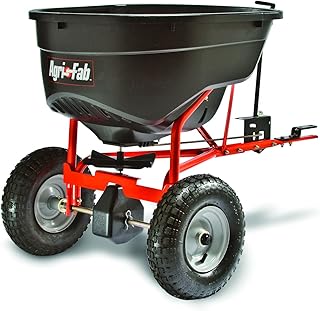
Agri-Fab Pull Behind Broadcast Spreader
Check PriceEven experienced gardeners slip up when they get complacent. The most common error is calibrating the spreader on top of the lawn. If you spill a pile of granules during the calibration process, you will burn that spot. Always calibrate over a tarp in the driveway.
Another frequent mistake involves mowing timing. You should mow the lawn 2 to 3 days before applying fertilizer, never the same day. Mowing creates micro-wounds on the grass blades, and if a heavy salt-index fertilizer lands on those fresh cuts, it causes tip burn. Let the grass heal before you feed it.
Finally, do not guess the square footage of your lawn. Guessing leads to over-fertilizing by 30% or more. Pull out your property survey or use a GPS measuring tool to calculate the exact area of turf you actually have, subtracting the house, driveway, and gardens. Accurate measurement is the bedrock of trusted results, a principle supported by agronomy experts at University of Minnesota Extension.
Frequently Asked Questions

Qaobo Handheld Spreader
Check PriceShould I mow before I spread fertilizer?
Yes, but allow a buffer of a couple of days. Mowing 48 hours prior allows the grass wounds to seal up. If you mow right after fertilizing, you will likely vacuum up the granules before they dissolve, wasting your time and money completely.
What happens if it rains right after I fertilize?
A light, steady rain is perfect because it waters the fertilizer in for you. A violent storm that causes puddles is dangerous. If water starts rushing across the surface of the lawn, the fertilizer will wash into low spots, creating heavy burn zones in the valleys and starvation on the hills.
Why does my lawn have dark green stripes?
Dark green stripes mean you are overlapping your passes by too much or your spreader pattern is off-center. The overlap areas are receiving a double dose of nitrogen. Switch to the half-rate cross-hatch method described above to fix this immediately.
Can I mix grass seed and fertilizer together?
You can, but it is often better to apply starter fertilizer separately or use a spreader designed to handle different particle sizes. Granular fertilizer is heavy and dense, while grass seed is light and fluffy. When mixed in a standard broadcast spreader, they separate, causing a patchy application.
Conclusion
Perfecting how to spread fertilizer on lawn is a science of inputs and a craft of walking patterns. When you take the time to calibrate your machine, map out your headlands, and commit to the cross-hatch walking routine, the reward is a carpet of uniform, vibrant grass that resists pests and disease naturally.
Remember that the secret to a professional finish is in the preparation, not just the product. Store your spreader properly, always sweep your hard surfaces clean, and water deeply but gently. Follow these steps consistently, and your lawn will become the benchmark for the entire neighborhood.
