
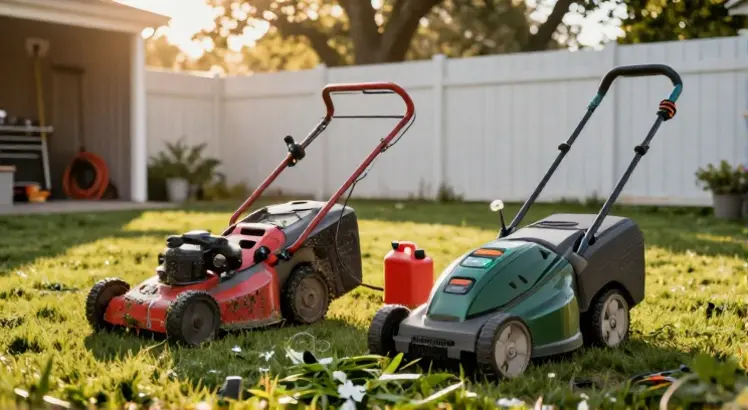
When you stand in the aisle of a home improvement store or scroll through dozens of online listings, the cordless vs gas lawn mower debate can feel overwhelming. I have used both types on suburban lawns and rough country lots, so I understand what matters most. You need a machine that fits your yard size, handles your grass type, and matches your tolerance for mess and noise. This guide breaks down every critical difference so you can stop guessing and make a confident choice.
How Cordless and Gas Lawn Mowers Work

MZK LM13B4 13-Inch Brushless Cordless Lawn Mower
Check PriceBefore diving into performance numbers, it helps to understand the basics. A cordless mower runs on rechargeable lithium-ion batteries, usually one or two packs mounted on the deck. A gas mower uses a small internal combustion engine that burns gasoline and oil.
Battery-Powered Cordless Mowers
A cordless mower draws electricity from a battery pack to spin the blade with a direct drive motor. There are no spark plugs, air filters, or carburetors. The blade stop is instant when you release the bail, which adds a layer of safety I appreciate when kids or pets are nearby.
Today’s lithium-ion batteries give consistent power until they are nearly empty. You do not lose cutting speed as the charge drops. Voltage ratings range from 18V for small push mowers up to 80V or more for self-propelled models that challenge gas machines.
Gas-Powered Mowers
Gas mowers have been the standard for decades. A four-stroke, or sometimes two-stroke, engine spins the blade and often powers the drive wheels. This setup provides raw, sustained energy for thick, wet grass and acre-sized lawns.
Gas engines generate more friction and heat, which means more parts to wear out. You will deal with fuel, oil changes, air filter replacements, and seasonal tune-ups. For many, that maintenance is a fair trade for unlimited runtime as long as a gas can is nearby.
Power and Performance Comparison

Greenworks 40V 16-Inch Cordless Push Mower
Check PricePower is the first thing people ask about in the cordless vs gas lawn mower discussion. Old battery mowers struggled to cut a full bag of grass without bogging down. That has changed dramatically in the last five years.
Gas mowers typically deliver 3.5 to 7.0 foot-pounds of torque, depending on engine displacement. High-voltage cordless mowers now deliver peak torque instantly, often matching that range. As we saw in our detailed cordless mower showdown, modern brushless motors can out-accelerate small gas engines right off the start.
Cutting Thick Grass and Weeds
Where gas still shines is in unrelenting heavy loads. If you regularly mow tall Bahia grass, wet St. Augustine, or overgrown field edges, a gas engine’s wide torque band keeps the blade turning at full RPM. A cordless mower may engage its electronic overload protection and pause briefly, which forces you to slow down or raise the deck.
For typical residential lawns with fescue, bluegrass, or Bermuda that is cut weekly, a 40V or 60V cordless mower handles the job without complaint. I have used both and rarely missed the gas motor on a well-maintained yard.
Runtime and Refueling Convenience

KOMASTY 40V 16-Inch 2-in-1 Cordless Mower
Check PriceRuntime is where your yard size and patience collide. Cordless mowers run on battery capacity measured in amp-hours, giving you anywhere from 25 to 70 minutes of real-world mowing per charge. Most manufacturers sell compatible batteries, so you can swap packs for continuous runtime.
Gas mowers have one clear advantage. Fill the tank in two minutes and you are back to work for up to two hours or more. Refueling is universally fast, and you never worry about a lithium-ion battery degrading after a few hundred cycles.
Battery Life vs Gas Tank
A typical cordless mower with a 5.0Ah battery can finish about half an acre on a single charge under moderate conditions. Going larger than that means investing in a second, high-capacity battery or choosing an 80V model. Gas simply dominates when you need to mow an acre or more without stopping.
The storage factor matters too. Battery packs can be charged indoors, safe from freezing garage temperatures that hurt performance. Gasoline must be stabilized, stored in approved cans, and kept away from ignition sources. That alone pushes some homeowners toward cordless.
Maintenance and Long-Term Costs

Greenworks 60V 21-Inch Brushless Push Mower
Check PriceThis is where cordless mowers win by a landslide. The motor has one moving part. There is no oil to change, no spark plug to foul, and no carburetor to gum up from old ethanol fuel. Every spring I hear stories of gas mowers that refuse to start because fuel was left in the tank over winter.
Cordless Mower Upkeep
You sharpen or replace the blade, clean the deck underside with a scraper or hose, and periodically check the battery contacts. That is almost the entire maintenance list. If you want to explore specific models, our list of top-rated cordless mowers can point you in the right direction.
Batteries are the largest long-term cost. A replacement 5.0Ah pack from a premium brand can run over $200. However, after three to five years of heavy use, that cost is still often lower than what you would spend on gas, oil, air filters, and spark plugs for a gas mower over the same period.
Gas Mower Maintenance
Gas mowers ask for seasonal attention. You need to change the oil every 25 to 50 hours, replace the air filter, check the spark plug, and possibly clean the carburetor. Ethanol-blended fuel attracts moisture and degrades quickly, leading to hard starts and rough idle.
Neglect that maintenance and a gas mower will degrade faster than a neglected cordless one. The time and frustration of annual tune-ups are hidden costs many first-time buyers overlook.
Environmental Impact and Noise

WORX Nitro WG752 21-Inch Brushless Push Mower
Check PriceGas mowers emit hydrocarbons, nitrogen oxides, and carbon monoxide directly at ground level. According to Sciencedaily, running a gas mower for one hour can produce roughly the same smog-forming emissions as driving a modern car for 100 miles. That is a staggering figure for a machine you push around your yard.
Cordless mowers produce zero exhaust emissions at the point of use. The environmental impact shifts to electricity generation, but even on a coal-heavy grid, the total emissions per lawn cut are drastically lower. Noise is another win. A gas mower runs at 90 to 100 decibels, loud enough to require hearing protection. Most cordless mowers hum at a gentle 70 to 75 decibels, which makes early morning or evening mowing neighbor-friendly.
Cost Comparison: Upfront and Operating
You will find gas mowers starting at around $200 for a basic push model and climbing to $500 for a self-propelled unit from a reputable brand. Cordless mowers start closer to $300 for a small 18-inch deck and jump to $700 or $800 for a high-voltage self-propelled version with two batteries.
While the upfront price of a quality cordless mower is higher, operating costs reverse the trend. Gasoline, two-cycle oil, replacement filters, and maintenance supplies add up. Cordless mowers cost pennies per charge in electricity and almost nothing else until the battery eventually needs replacement. I have tracked my own costs over three seasons and found the cordless setup cheaper by the second year.
Yard Size and Terrain Suitability
Small yards under a quarter acre are pure cordless territory. A single battery charge easily covers the area, and the lightweight design makes maneuvering around flower beds and tight corners effortless. Slopes and hills favor gas mowers with their heavier build and stronger traction, though many self-propelled cordless models now handle moderate inclines well.
For properties over half an acre, choose gas if you value uninterrupted mowing. Choose cordless only if you are willing to buy an extra battery or take a break while charging. Large rural lots with dense, weedy patches still demand the brute force of a gas engine, but suburban lots with well-irrigated turf are ideal for battery power.
Which Lawn Mower Is Right for You?
This decision narrows down to your lawn size, your tolerance for maintenance, and how you feel about fumes and noise. If you want a quick, clean push-button start with almost zero upkeep, a cordless mower will make you happy. If you need to mow an acre of thick grass in one go and do not mind wrenching on a small engine once a year, gas is still tough to beat.
I often recommend cordless to first-time homeowners because the simplicity keeps them mowing consistently. Experienced users with large properties and a workshop full of tools tend to stick with gas because they already have the maintenance habit and need the endurance.
Frequently Asked Questions
Can a cordless mower handle tall weeds?
Yes, high-voltage models with sharp blades cut weeds up to 12 inches tall, but you may need to slow down and overlap passes. Gas mowers chew through tall weeds more aggressively without stalling.
How long do cordless mower batteries last?
A lithium-ion pack typically lasts 3 to 5 years or about 300 to 500 charge cycles. Proper storage at room temperature and avoiding deep discharges extends lifespan.
Is mulching better with gas or cordless?
Both types mulch equally well when equipped with a dedicated mulching blade and a plug insert. Cordless mowers often spin at a constant high RPM that delivers fine clippings.
Do gas mowers last longer than cordless mowers?
A well-maintained gas mower can last 8 to 10 years or more. Cordless mowers have fewer mechanical parts to fail, so the chassis often outlasts the batteries. Replacing a battery after 5 years extends the machine’s usable life significantly.
What is quieter, cordless or gas?
Cordless mowers are dramatically quieter, running around 70 to 75 decibels versus 90 to 100 decibels for gas. That is roughly the difference between a normal conversation and a motorcycle engine.
Conclusion
The cordless vs gas lawn mower debate has a different winner depending on your specific yard and lifestyle. For most suburban homes, cordless delivers a clean, hassle-free mowing experience that keeps improving every model year. Gas remains the heavyweight champion for raw endurance and tackling the toughest mowing conditions without flinching.
Assess your lawn’s size, look honestly at your willingness to maintain a small engine, and test the decibel level you can live with. Once those factors are clear, the right mower becomes obvious. Whichever you choose, keep the blade sharp and the deck clean, and you will get a great cut all season long.
