
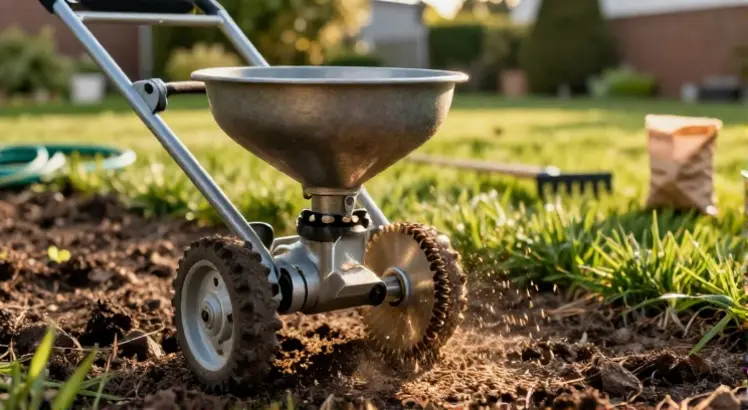
You have probably stood in your yard with a bag of expensive grass seed, wondering if there is a better way than throwing it by hand. Tossing seed with your fingers feels natural, but the results often look like a patchy quilt rather than a lush carpet. If you are tired of uneven growth and wasted seed, you have likely asked the question, Are grass seed spreaders worth it?
The short answer is yes, for most homeowners, a spreader pays for itself quickly. It does more than just scatter seeds, it controls the distribution so precisely that you avoid the feast or famine look in your soil. High quality grass seed is not cheap, and a spreader ensures every single granule lands exactly where it can do the most good.
I have repaired countless lawns where hand seeding created a mess of bald spots and thick clumps. The difference between a professional finish and a backyard disaster often comes down to the tool you use. Let’s dig into why this simple piece of equipment might be the missing link in your lawn care routine.
Why Hand Spreading Fails Most Homeowners

Scotts Turf Builder EdgeGuard DLX Broadcast Spreader
Check PriceTo understand the value of a mechanical spreader, you first need to recognize the flaws in the manual method. Hand spreading seems cost effective, but it introduces several problems that can ruin your lawn’s potential. The human hand simply cannot replicate the consistency of a calibrated machine.
When you throw seed manually, you naturally release more in the center of your arc and less at the edges. This creates a pattern of heavy concentration directly in front of you, while the sides starve. You also tend to overcompensate on areas you already hit because you cannot see the tiny seeds clearly on the soil.
The Problem of Overcrowding and Waste
Seedlings are competitive by nature. If you drop too many seeds in one spot, they fight for water, sunlight, and nutrients. Ultimately, the entire clump weakens and dies, a phenomenon known as damping off. You lose the vigor you paid for when you bought that premium seed blend.
A spreader solves this by metering out a specific rate per square foot. You simply walk at a steady pace, and the tool does the math for you. This prevents the heartbreaking sight of seeded areas turning yellow and collapsing because they were too thick from the start.
The Precision Payoff: Saving Seed and Money

Amazon Basics Fertilizer Spreader
Check PriceThe direct financial argument for a spreader is compelling. When you throw seed by hand, you almost always use more than the bag recommends. You do this subconsciously because you fear bare spots. A spreader eliminates the guesswork, allowing you to cover more ground with the exact amount of seed you bought.
In my experience, hand seeding typically leads to a 20 to 30 percent waste factor. After just two or three applications, the money you spent on a spreader equals the savings from not wasting seed. If you are using coated, high end seed varieties, a single project’s savings can pay for the tool entirely.
Achieving Uniform Germination Rates
A lawn looks best when the germination happens simultaneously. If seeds are scattered unevenly, some sprout early and shade out the slower patches. A spreader gives you a synchronized grow-in, where every inch of dirt wakes up at roughly the same time, leading to that dense, professional mat you admire in magazines.
Uniformity is not just about looks. A dense, even turf naturally blocks out weeds. If you leave thin patches because of poor distribution, crabgrass and dandelions will exploit those openings. The spreader becomes a weed prevention tool simply by building a stronger, unbroken canopy of grass.
Rotary vs. Drop Spreaders: Choosing Your Weapon

VEVOR Broadcast Spreader 50LBS
Check PriceNot all spreaders are created equal, and your specific lawn will dictate which one is worth your money. The two main players are the broadcast, or rotary, spreader and the drop spreader. Understanding the physics of both is crucial before you buy, otherwise, you might introduce new problems at the edges of your lawn.
- Broadcast (Rotary) Spreaders: These use a spinning disc to fling seed out in a wide fan pattern. They are fast and perfect for large, open expanses. However, they require a bit of skill near flower beds, because the throw can easily scatter seed into places you do not want grass to grow.
- Drop Spreaders: These drop seed straight down between the wheels. They are incredibly precise and tightly controlled for edges. The downside is speed, as you must overlap your wheel tracks perfectly. You can also create stripes if you are not careful, leaving lines of unseeded soil.
Double Duty as a Fertilizer Applicator
Here is where the value proposition of a spreader becomes undeniable. You are not buying a unitasker. The same machine you use to spread grass seed efficiently also handles granular fertilizer, pelletized lime, and even ice melt in the winter. A high quality model transforms into a year round lawn health station.
This versatility means the cost per use drops dramatically. When you factor in the savings from buying bulk granular products instead of expensive liquid hoses, the spreader upgrades from a luxury to a necessity. It ensures that your fertilizer, like your seed, never overlaps and burns the turf.
The Time Equation: Speed Without Sacrifice

Chapin 25lb Handheld Seed Spreader
Check PriceTime is a currency just as valuable as money. Hand seeding a quarter acre lot can take an entire sweaty afternoon, while a broadcast spreader can finish the job in 15 minutes. That efficiency encourages you to stay on schedule with your reseeding windows, which are often short during the fall and spring.
Furthermore, a spreader eliminates the mental load of constant quality checking. You trust the gear mechanism to release a set rate, so you can focus on walking straight lines. Push powered models exist too, but even manual walk behind units provide a massive step up from the primitive hand toss method.
Protecting Your Soil pH and Structure
Uneven seeding often leads desperate homeowners to dump extra water or fertilizer on struggling spots. This over saturation can alter the pH of specific soil pockets. A spreader creates an even canvas where your entire soil structure receives equal treatment, making your best fertilizer spreader for lawn efforts actually pay off.
When you maintain an even surface, water runoff patterns stay uniform too. You won’t get ruts where clustered seeds hold moisture too long. This regulated growing environment fosters deeper root systems, which are the secret to drought resistance in the summer months.
When a Hand Toss Still Makes Sense

VEVOR Compost Spreader
Check PriceTo be balanced, there are a few specific scenarios where a spreader might be overkill. If your lawn is tiny, roughly the size of a bedroom, the setup and cleaning of a push spreader might feel tedious. In these micro spaces, hand tossing can work if you take extreme care to mix the seed with a carrier like sand for visual contrast.
Another exception is spot repair on steep slopes. Push spreaders can tip over or lose calibration on a severe pitch. For filling a small dog spot or a divot, a hand crank bag seeder offers the middle ground. But for any area where you aim for total uniformity across more than 200 square feet, the mechanical option wins easily.
The Calibration Guarantee
One major concern beginners have is calibration. They fear the spreader will dump the entire hopper in one spot. Modern spreaders come with simple settings based on the product bag instructions. You simply dial in the number, walk at a brisk human pace, and the internal agitator does the work reliably.
If you are still nervous, always test the spreader on a tarp or driveway first. This lets you physically see the width of the throw pattern. It demystifies the process and confirms that the tool is a precise instrument, not a blind randomizer.
Durability and Long Term Value
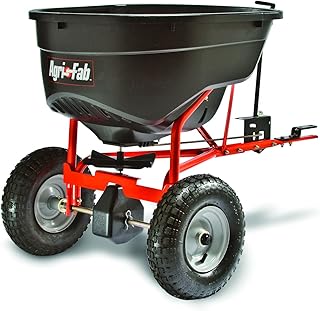
Agri-Fab Pull Behind Broadcast Spreader
Check PriceMany homeowners shy away from buying a spreader because they worry it will rust out in the shed after one season. The truth is, a well maintained spreader lasts for decades. The key is to wash out the hopper after every use, especially when using corrosive fertilizers, and lubricate the axle bearings occasionally.
Materials matter here. A poly hopper will never rust, whereas painted metal requires more vigilance. Pneumatic tires ride smooth over bumpy turf without bouncing and skipping. The initial investment in a sturdy unit might cost slightly more, but the plastic gears in budget models can strip under the weight of a full load of seed.
According to lawn care standards outlined by the Cooperative Extension System, proper equipment maintenance is just as critical as biological knowledge for turf success. A jammed spreader can cause a massive chemical burn or a seeding failure, so quality construction truly matters.
Avoiding the Striped Lawn Nightmare

Qaobo Handheld Spreader
Check PriceThe biggest complaint I hear from people who bought a drop spreader is the striping effect. They see alternating green and yellow lines after germination. This is an operator technique issue, not a tool flaw. To avoid it, you must cut the recommended setting in half and apply in two passes at right angles.
If using a rotary spreader, you create a half rate grid pattern over the lawn. This method fills in any potential hollow areas in the distribution pattern. The extra walking is worth the frustration it saves later. You will find that using a tool correctly makes the difference between worth it and regret buying it.
Health Benefits of Reduced Bending
Let’s not ignore ergonomics. Hand seeding requires you to hunch over, dive into a bag, and swing your arm thousands of times. For older gardeners or those with back pain, this repetitive motion is a recipe for injury. A push spreader keeps your spine upright and your shoulders relaxed.
The gentle walking pace required for a spreader is actually pleasant exercise. It turns a grueling chore into a mindful stroll around your property. That shift in physical strain alone can make a spreader worth its weight in chiropractor bills.
Frequently Asked Questions
Can I use a hand me down fertilizer spreader for seed?
Absolutely. In fact, using a dedicated spreader for seed and another for chemicals is a best practice, but if you clean it thoroughly, you can use one for both. Just test the gate opening, as grass seed is often larger than fertilizer granules, requiring a wider slot setting on the hopper.
How do I stop seed from crumbling in the hopper?
Crumbling usually happens because moisture got into the seed bag or the hopper was damp. Always start with a dry, clean spreader. If the internal agitator pin is too aggressive for a delicate coated seed, check if your model allows you to remove every other pin to reduce friction.
Is a tow behind spreader better than a push spreader?
This depends on your property size. For an acre or more, a tow behind model connected to a lawn tractor is definitely worth it. For standard suburban lots under half an acre, a push broadcast spreader offers more agility and tighter cornering without the hassle of hitching up a tractor.
Can I use a spreader for overseeding an existing lawn?
Yes, and this is where spreaders truly shine. The drop spreader specifically excels at getting seed down past the canopy of existing grass, where it can reach the soil. A rotary spreader works too, but you might need to rake lightly afterward to filter the seeds down.
Final Verdict on Seed Spreading
So, are grass seed spreaders worth it? Unless your yard is the size of a postage stamp, the answer is an enthusiastic yes. The precision, speed, and material savings convert a high risk guessing game into a predictable science. You get a thicker lawn with less effort and less money wasted on seed.
Your lawn is a living investment, and a spreader is the tool that ensures your deposits grow. Whether you choose rotary speed or drop accuracy, the baseline improvement over hand seeding is massive. I recommend you start with a simple broadcast model, perfect your walking speed, and watch your yard transform from patchy dirt into a flawless green zone.
Do not let your hard work go to waste on poor application technique. Pick a spreader that feels solid, calibrate it with a simple driveway check, and enjoy the peace that comes from knowing every single seed has a fighting chance. The moment you see that even green haze sprouting uniformly across your soil, you will never question the value again.
